Portugal’s Summer Celebrations – What to Expect

Santos Populares Graca, Lisbon

Summer is the season of celebrations in Portugal. If you’ve never spent a summer in Portugal, here’s what no one quite tells you in advance: from early June through to the end of August, the entire country is essentially celebrating something. Saints’ days, fireworks, processions, rock festivals, seafood feasts, all-night street parties in narrow tiled alleys. Summer celebrations roll on, weekend after weekend, often several things at once in different cities.

It’s wonderful. It’s also a lot. Knowing what’s happening, where, and how to actually enjoy it without melting or losing your kids in a crowd makes a real difference. Here’s our month-by-month guide to Portugal’s summer celebrations in 2026, written from Lisbon, with honest local notes on what to expect and a few practical suggestions for travelling families, grandparents, and anyone who’d rather rent the bulky stuff than haul it across borders.

What’s the best month to visit Portugal for summer festivals?

Honestly, all three are brilliant in different ways. June is the most concentrated because the Santos Populares (Popular Saints) take over Lisbon and Porto; the streets are absolutely electric, and the country has a giddy, just-starting-the-summer energy. July shifts the centre of gravity to the Algarve coast and the northern romarias (pilgrimage fairs), with big seafood festivals and surf-and-music events. August is quieter inland but spectacular in the north, where some of Portugal’s most photogenic religious festivals take place against a backdrop of embroidered costumes and naval parades.

If you can only pick one weekend, the night of 12-13 June in Lisbon for Santo António is hard to beat. If you want something more visually extraordinary and less touristy, aim for 20-24 August in Viana do Castelo.

June in Portugal

Saints, sardines and Rock in Rio

June is dominated by the Santos Populares,  the Popular Saints, a tradition that turns ordinary residential streets into open-air parties. People drag fold-out tables onto the cobbles, fire up charcoal grills loaded with sardines, hang paper streamers from balcony to balcony, and dance to pimba music until the small hours. It is gloriously informal and worth planning a trip around.

Here are the dates that matter:

  • 4 June (Thursday) – Corpus Christi. A national religious holiday with processions in Braga, Porto and many rural towns. Most shops close.
  • 6-13 June – Semana do Município de Cascais. A week of concerts, fairs and maritime events in this chic coastal town just outside Lisbon.
  • 10 June (Wednesday) – Dia de Portugal (Dia de Camões). The national day is marked by official ceremonies in Lisbon and Porto and by Portuguese communities abroad.
  • 12-13 June – Noite de Santo António. The peak of Lisbon’s celebrations. The 12th into the 13th is the all-nighter — sardines, wine, marchas populares parading down Avenida da Liberdade, and dancing in Alfama, Mouraria and Bica until sunrise.
  • 13 June (Saturday) – Dia de Santo António. Lisbon’s municipal holiday. The city sleeps it off, then does it again.
  • 20, 21, 27 & 28 June – Rock in Rio Lisboa. Two weekends at the new Parque Tejo venue (it’s moved from Bela Vista), with a 2026 lineup including Katy Perry, Linkin Park, Rod Stewart, Florence + The Machine and a long list of Portuguese acts.
  • 23-24 June – Noite de São João (Porto) — according to the Câmara Municipal do Porto, the traditional celebration runs the night of 23 into 24 June every year, with 24 June as Porto’s municipal holiday. If you only do one thing in Porto, do this. Avenida dos Aliados and the Douro riverbank fill with locals carrying plastic hammers (yes, you hit each other on the head, gently; it’s a thing), balloons drifting up into the sky, grilled sardines, basil pots, and fireworks over the river at midnight.

Local tip: The marchas populares, the costumed neighbourhood parades on Avenida da Liberdade on the evening of 12 June, are spectacular but absolutely jammed. If you’re with small children or older relatives, watching from a café terrace on a side street is far more pleasant than fighting the crowd at the barriers. Bring a napkin to the sardine grills on the 12th and accept that you will smell like charcoal and fish for the rest of the night. That’s part of the magic.

Santos Populares Braga

July in Portugal

Feasts, festivals and football

Portugal’s summer celebrations don’t end there. By July, the local celebrations are replaced with music festivals. Hosted every weekend and all around the country. The pace is a touch more relaxed than June’s saint-fever, the days are longer, and the coast genuinely comes alive.

  • World Cup – if there is one thing you should know about Portugal, it’s the importance of 3 x Fs – football, fado and Fatima. All sacred and equally important. Therefore, with the World Cup in full swing, every restaurant, pastelaria, coffee shop and square turns into a screening room for the football games. Portugal is playing on the 3rd and 6th of July, and you can expect the city to be all focused on one thing around the match time. If you are in Lisbon, you can fully enjoy the atmosphere by watching the game at the city’s Football Arena here.

  • 9-11 July, NOS Alive, Lisbon – One of Portugal’s leading mega-festivals, known nationally for bringing huge international stars to the country. Be prepared for sunny weather, an eclectic lineup including Foo Fighters, Twenty One Pilots, Florence and The Machine, and many more!

  • 10-12 July – RFM Somni,  Figueira da Foz – Portugal’s biggest electronic music and beach festival, known as “The Biggest Sunset Ever.” It transforms a stunning Atlantic coastline into a massive open-air dancefloor. Features top-tier EDM, techno, and electronic artists including Hardwell, Timmy Trumpet, Dual Damage, and the famous Padre Guilherme.

  • 17 – 19 July – MEO Mares, Matosinhos (Porto) – is one of the largest summer music festivals in Northern Portugal. It features a lineup spanning pop, rock, and hip-hop, drawing tens of thousands of attendees.

  • Early July – Feira da Batalha. A medieval-themed fair near Fátima with jousting, costumes and food stalls is a great family day out if you’re touring central Portugal.
  • Mid-July – Nossa Senhora da Boa Viagem. A seafaring procession in Cascais and Nazaré, with the statue of Our Lady carried out to sea on decorated fishing boats. Striking, photogenic, and surprisingly moving.
  • NEXT YEAR – July 18-25, 2027 – Boom Festival – The closest experience that Europe has to the American Burning Man, this psychedelic festival in Portugal fosters a rabid fan base. With a venue perched on a lush lakeside meadow, Boom is a biennial festival, so you’ll have to wait until next year.

August in Portugal

National holidays and the spectacular north

August in Lisbon empties as half the city seems to decamp to the Algarve. If you head north, you’ll find some of Portugal’s most striking and least-touristy celebrations of the year.

  • 6-8 August – NeoPop Electronic Music Festival, Viana do Castelo -Portugal’s premier techno and electronic music event. Celebrating its 20th anniversary as the “ANTIPOP” edition,  featuring legendary artists like Nina Kraviz, Indira Paganotto, and Héctor Oaks
  • 8-10 August – Romaria de Santa Marta, Viana do Castelo. A traditional festival with intricate flower-petal carpets laid along the procession route.
  • 10-15 August – Festival do Marisco, Olhão. The Algarve’s biggest shellfish celebration. Ten days of seafood, live music, and absolutely no pretence at moderation. Book accommodation well ahead.
  • 15 August – Assunção de Nossa Senhora (Assumption of Mary). A national holiday. Big processions in Viseu, Lamego, and especially Braga, where the Bom Jesus do Monte sanctuary becomes the focal point.
  • First half of August – Paredes de Coura Festival. The iconic rock and indie festival is held in a wooded river valley near the Spanish border. Considered one of Europe’s loveliest small festivals,  campers swimming in the river between sets.
  • 20-24 August – Festas da Senhora d’Agonia, Viana do Castelo. If you only see one Portuguese religious festival in your life, make it this one. Embroidered costumes that have been in families for generations, flower carpets laid through the old town, a naval procession on the Lima river, and a fireworks display that’s genuinely worth the trip north.
  • 28-30 Aug – MEO Kalorama, Lisbon – a major annual music, art, and sustainability festival held in Parque da Bela Vista featuring a mix of globally renowned headliners and emerging talent across rock, pop, and electronic genres.
  • Last week of August – Feira de São Mateus, Viseu. One of the oldest fairs in Portugal — agriculture, funfair rides, and concerts running well past midnight.

Quick reference: main municipal holidays in summer 2026

CityHolidayDate
LisbonSanto António13 June
CascaisSemana do Município6-13 June
PortoSão João24 June
BragaAssunção de Nossa Senhora15 August
Viana do CasteloSenhora d’Agonia20-24 August

What should you bring (or rent) for a Portuguese summer festival?

One of the small joys of travelling light to Portugal in summer is realising you don’t actually have to drag bulky kit across an airport. A lot of the gear that makes the difference between enjoying a festival and surviving one is genuinely easier to rent on arrival, especially if you’re flying with kids, visiting grandparents, or planning a week that mixes city celebrations with beach time.

A few practical things worth thinking about ahead of time:

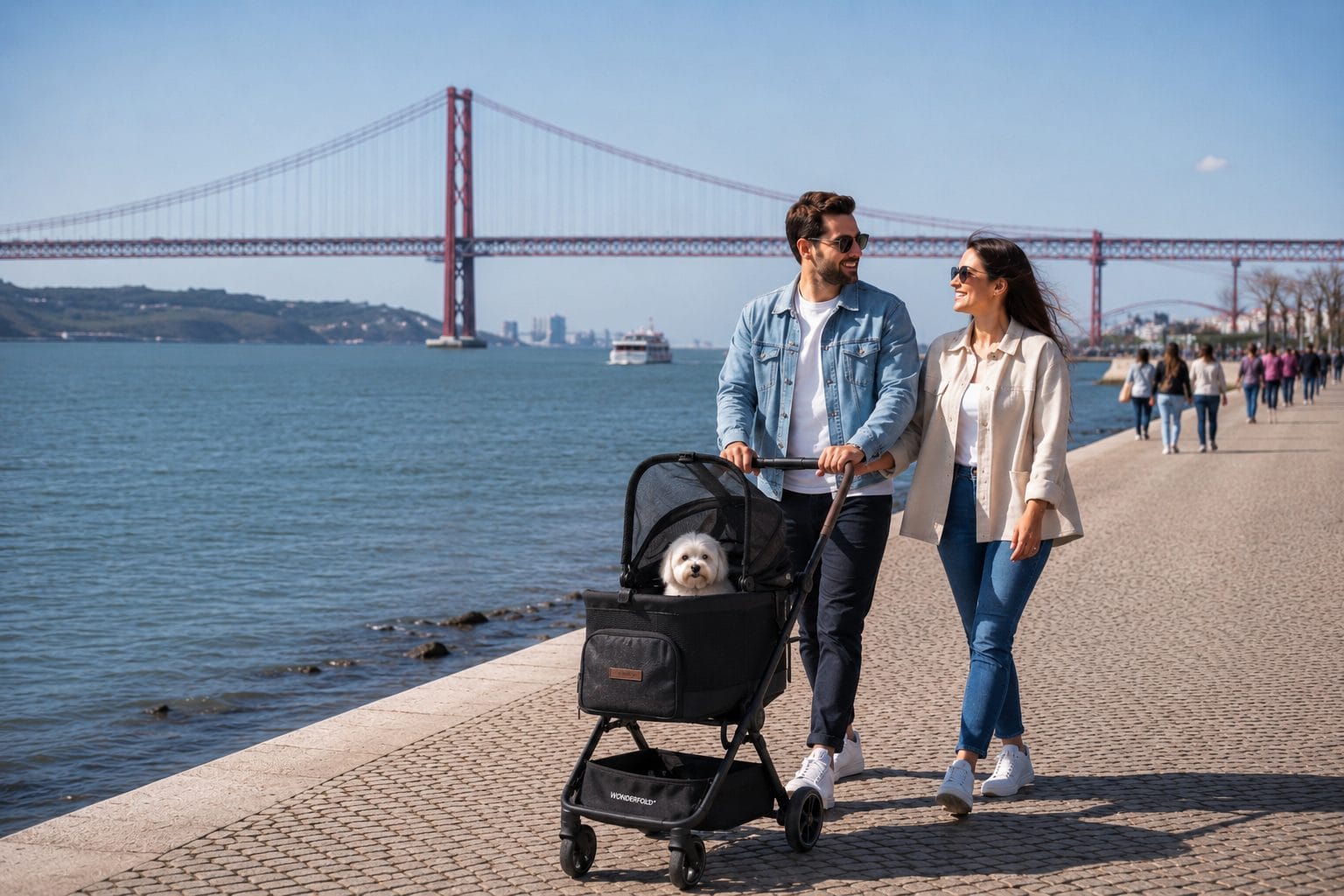
  • If you’re travelling with babies or small children through the Santo António crowds or down to a seafood festival, a robust travel stroller or a baby carrier is essential — the cobbles in Alfama and the old quarters of Porto and Viana are unforgiving, and crowded streets are not the place for a flimsy buggy. A stroller, travel cot or a car seat means one less thing to wrestle through baggage claim.
  • If older relatives are travelling with you for the processions, a rented wheelchair, rollator or mobility scooter makes the difference between joining in and sitting at the hotel. Many Portuguese festival routes involve long stretches of standing around and uneven ground, so having proper mobility support is a small investment that pays off throughout the entire trip.
  • For evening concerts and outdoor cinema (and there’s plenty of both in June and July), a portable cool box, folding chairs and a picnic blanket turn a long wait into a proper experience. Locals do this routinely for Rock in Rio queues and the Santo António marchas.
  • For your apartment, the thing most visitors underestimate is how warm Portuguese flats get at night during heatwave weeks, and most Lisbon and Porto apartments have no air conditioning at all. A portable AC or a couple of decent fans rented for the duration of your stay is genuinely one of the better travel decisions you can make in July or August.
  • If you’re working remotely while you travel and planning to extend the trip around the festivals, a proper desk setup (monitor, chair, decent lighting) is far cheaper than a cowork.

You can browse what’s available across Lisbon and the surrounding areas at Rent Anything. Delivery is straightforward, and pick-up at the end of your trip means you’re not stuck dragging gear back home with you.

How to actually enjoy a Portuguese summer festival

A few honest pieces of advice from someone who lives here. Eat before you arrive, because queues at the sardine grills can be long, and you’ll be more patient with food in you. Wear shoes you don’t care about; sardine grease and spilt ginjinha are real. Drink water between the wines. Don’t try to do two cities in one weekend during Santo António and São João week — the trains and roads are at capacity, and you’ll spend more time travelling than celebrating. If you’re staying in Lisbon for the night of the 12th, walk home rather than trying to get a taxi at 3 am; the trains and metro often run all night, and the streets are perfectly safe with crowds still milling about.

And finally: don’t try to plan every minute. The best Portuguese summer nights are the ones you stumble into, a back-street bairro party in Graça, a fado singer who’s set up a speaker outside their front door, a fish grill on a corner where the family has been doing this since the 1970s. Leave space in your evenings for the city to surprise you.

Portugal summer festivals FAQ

When is Santo António in Lisbon 2026?

Santo António is celebrated on 13 June 2026 (a Saturday), but the main party runs through the night of 12-13 June. The marchas populares parade down Avenida da Liberdade on the evening of the 12th, with street parties in Alfama, Mouraria and Bica continuing until sunrise.

When is São João in Porto 2026?

São João falls on 24 June 2026 (a Wednesday) and is Porto’s municipal holiday. The main celebration is the night of 23-24 June, with street parties along the Douro riverbank, fireworks at midnight, and the famous tradition of bopping strangers on the head with plastic hammers.

Santos Populares Graca, Lisbon

What are the dates for Rock in Rio Lisboa 2026?

Rock in Rio Lisboa 2026 runs across two weekends: 20, 21, 27 and 28 June. The festival has moved to a new venue at Parque Tejo (formerly held at Parque da Bela Vista), with shuttle services running from Oriente station. The 2026 lineup includes Katy Perry, Linkin Park, Rod Stewart and Florence + The Machine.

Is Portugal hot in July and August?

Yes, often very. Inland Portugal regularly hits the mid-30s Celsius in July and August, and Lisbon apartments without air conditioning can stay warm long into the night. Coastal towns are usually a few degrees cooler thanks to the Atlantic breeze. Portable fans and AC units are heavily in demand during heatwave spells, so booking accommodation cooling solutions ahead of time is wise.

Is Portugal accessible for travellers with mobility needs during festivals?

It varies. Major events like Rock in Rio offer dedicated accessibility services, and most large city processions have viewing areas with step-free access. However, many of the most atmospheric celebrations take place in old neighbourhoods with cobbled streets, steep alleys and stairs — Alfama in Lisbon and Ribeira in Porto in particular. Renting a sturdy mobility scooter, wheelchair, or rollator locally is usually a more practical option than bringing one from abroad.

Do shops close during Portuguese national holidays?

Most independent shops and many smaller restaurants close on national holidays (Corpus Christi on 4 June, Portugal Day on 10 June, Assumption on 15 August), and on municipal holidays in the relevant city (Santo António in Lisbon on 13 June, São João in Porto on 24 June). Supermarkets and tourist-area restaurants usually stay open, but with reduced hours.

About Rent Anything

This article is published by Rent Anything. Here is what the service is, in case you arrived here from a search.

What is Rent Anything?

Rent Anything is a short-term and mid-term equipment rental service operating in Lisbon and Paris.

Equipment rental refers to paying a daily rate for an item you use and then hand back, rather than buying it or carrying it with you. A mid-term rental means that the booking runs for weeks or months rather than days. Five ranges are stocked: baby and children's gear, mobility equipment, remote-work tech, home and living, and travel and outdoors. In short, you travel light and it is waiting when you arrive.

How does renting work?

Four steps: browse the catalogue, book your dates, take delivery or collect, then return the item at the end.

Rates are quoted per day and fall the longer you rent, because every product carries a rate ladder, also known as pricing tiers, rather than one flat price. For example, a week costs less per day than a weekend does. A minimum rental period refers to the shortest booking an item accepts, and it is stated on that item's own page beside its live availability. According to our own how-it-works guide, there is no deposit at any point. Therefore the figure shown for your dates is what those dates cost, not a starting price. Source: How it works.

Where do you deliver?

Across Lisbon and Paris, including both cities' airports and the Lisbon Cruise Terminal.

Delivery refers to us bringing the item to where you are staying - hotels, Airbnbs, serviced apartments and private residences - rather than you finding a depot. Specifically, it is priced from the distance between our warehouse in that city and the address you give, so the fee appears at checkout. In addition, free cancellation means that a booking can be cancelled at no charge up to 24 hours before it starts. Simply put, you book the address you are staying at and we handle both ends. Source: Frequently asked questions.

In summary

Key takeaways

  • Equipment rental in Lisbon and Paris, delivered to where you are staying.
  • Per-day rates that fall with length. No minimum period, no deposit.
  • Free cancellation up to 24 hours before the start date.
  • Everything is cleaned and sanitised between rentals.

Live prices and availability for any single item are on its own page. Source: the full catalogue.

Related Articles

If you’re planning a family trip to Europe, chances are you’ve already spent an evening staring at your child’s car

When summer temperatures soar and the Parisian asphalt starts to feel unbearable, the urge to escape to cool water and