
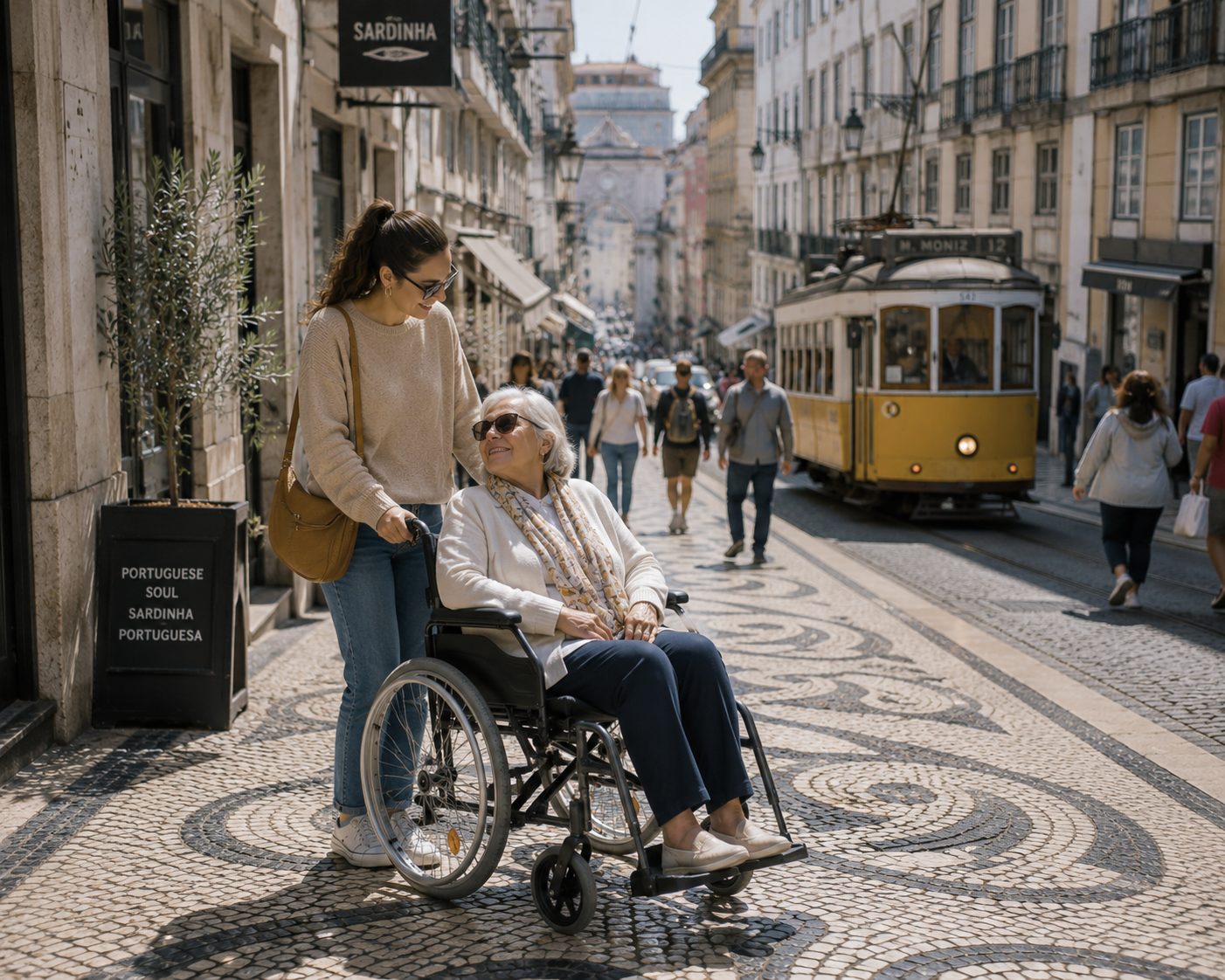
First, the Honest Truth About the Terrain
Lisbon is genuinely hilly, and the famous calçada portuguesa pavements are uneven, often sloped, and slick when wet. That’s the bad news out of the way. The trick is knowing that the city splits fairly cleanly into “easy” and “hard” zones, and planning your days around that split.The easy zones:- The riverfront. As a rule of thumb, anywhere along the Tagus is flat. You can follow the water from Cais do Sodré toward Belém, or along the promenades of Parque das Nações, without a single serious incline.
- Baixa (downtown). Rebuilt on a grid after the 1755 earthquake, Baixa has wide, level streets running from Rossio down to the grand riverside square of Terreiro do Paço, and along to Santa Apolónia.
- Belém. Spacious, flat, and home to many of Lisbon’s headline monuments.
- Parque das Nações. Built for Expo ’98, it’s modern, wide-paved, and about as flat as Lisbon gets.
- Avenidas Novas and Campo de Ourique. Both sit outside the historic centre, are largely level, and feel like real Lisbon neighbourhoods rather than tourist zones.
- Alfama, Graça, and Bairro Alto. Steep, narrow, cobbled, and with plenty of stairs. Absolutely worth seeing, but not on foot if walking is difficult.
- Chiado. Lovely, but mostly uphill from Baixa.
- Avenida da Liberdade. Wide and grand with great hotels, but it runs on a steady slope, so whether it feels easy depends entirely on which direction you’re going.
Choose Your Base Carefully (It Matters More Than You Think)
Where you sleep will shape every single day of your trip. A few things to check before you book:- Pick a flat neighbourhood. Baixa, the riverfront, Parque das Nações, or Avenidas Novas will make every outing start and end on easy ground.
- Make sure a car can reach the front door. Some historic streets are pedestrian-only or too narrow for vehicles. If a taxi has to drop you two cobbled blocks away, that’s two cobbled blocks every time you go out.
- Ask about the elevator. Plenty of older Lisbon buildings have no elevator, or a tiny one reached by a few steps. Ask the host directly, and ask about steps at the street entrance too.
- Check the room itself. Many larger hotels offer accessible rooms, but what “accessible” means varies a lot. Ask specifically about shower access, door widths, and grab rails if they matter to you.
Getting Around Without Wearing Yourself Out
The single best piece of advice for Lisbon with limited mobility: let transport do the climbing. Use it to get to the top of a hill and then explore downhill, or skip the steep bits altogether.Metro. The metro is your most reliable step-free option. As of late 2025, Lisbon Metro reported that 46 of its 56 stations have lifts and accessibility equipment, roughly 82% of the network. Two caveats: Baixa-Chiado, one of the most central stations, is very deep and doesn’t have full lift access, and lifts at any station can be out of service. Check before you rely on a specific station, and have a plan B.Buses and trams. Most of the Carris city bus fleet is low-floor with ramps. For Belém, the modern articulated trams on line 15E are low-floor and much easier to board. The famous vintage trams, including the iconic Tram 28, are a different story: high steps, narrow aisles, and usually packed. Admire them from the pavement.Taxis, Uber and Bolt. Ride-hailing is widely available and reasonably priced, and for many visitors with limited mobility it ends up being the backbone of the trip. Adapted taxis for wheelchair users also exist and can be booked in advance.Tuk-tuks. Not just a tourist gimmick. A tuk-tuk is one of the most practical ways to see Alfama and Graça if you can’t walk the hills, because they fit through streets cars can’t and will take you right up to the viewpoints. Agree the route and price up front.Trains to Sintra, Cascais and beyond. Portuguese Railways (CP) runs an assistance service called SIM (Serviço Integrado de Mobilidade) for help boarding and getting off trains. Request it on 808 100 746 or through the form on cp.pt. Wheelchair and mobility scooter users need to book in advance, at least 6 hours ahead, and assistance is only available at certain stations, so check yours first.At the airport. Lisbon Airport offers MyWay, a free assistance service for passengers with reduced mobility on arrival and departure. Request it through your airline when you book, or at least 48 hours before you fly.What to See (and How to See It Comfortably)
Belém. Probably the single best day out for limited mobility. The riverside is flat and spacious, the Jerónimos Monastery has step-free access to much of the site, and visitors with disabilities can often get priority entry and reduced or free tickets (bring documentation). The Monument to the Discoveries is best admired from outside, and Belém Tower has been undergoing restoration, so check whether it’s open before you go. The exterior is the main event anyway. The Coach Museum, the Centro Cultural de Belém, and MAAT along the river are all good accessible additions.Parque das Nações. Flat, modern, and easy. The Oceanário de Lisboa is one of Europe’s great aquariums and is fully accessible, and the riverside cable car gives you a gentle, sit-down view of the whole area.Baixa. Stroll the grid streets, Rua Augusta, and Terreiro do Paço. The Lisboa Story Centre on the square is a good indoor stop, and the Money Museum is nearby. The Santa Justa Lift will take you up toward Chiado (though not to the top viewing platform without stairs), and Time Out Market at Cais do Sodré is a level, easy lunch.The viewpoints. You don’t have to miss Lisbon’s famous miradouros. São Pedro de Alcântara, Santa Catarina, and Santa Luzia can all be reached by car or tuk-tuk, though the pavement around them can be uneven, so a helping hand is useful.Museums. The National Azulejo (Tile) Museum, the National Museum of Ancient Art, the Museu do Oriente, and the Saramago Foundation are all noted for good accessibility. Some larger museums lend wheelchairs at the entrance; check their websites before you go.A river cruise. One of the most relaxing ways to see the whole skyline, with zero hills involved. Check the boat’s boarding arrangements when you book.Beaches. Several beaches around Cascais and Costa da Caparica have wooden walkways onto the sand and adapted parking. Cascais itself has some slopes, but nothing like central Lisbon.A Few Things to Watch Out For
Read the fine print on Fado nights. Traditional Fado houses are often in old Alfama and Bairro Alto buildings with steps, and some booking pages say outright that they’re not suitable for people with mobility impairments.Rain changes everything. Wet calçada is genuinely slippery. On rainy days, lean on museums, the Oceanário, and door-to-door rides, and wear shoes with real grip.Pace yourself. Plan one “big” outing a day and keep the rest flexible. Lisbon rewards slow travel: long lunches, café terraces, and sunset views all count as sightseeing.Always ask about discounts. Many monuments and museums offer reduced or free entry for visitors with disabilities, sometimes for a companion too. Carry relevant ID and ask at the ticket desk.Injured Mid-Trip? Don’t Cancel, Adapt
If you twist an ankle on day two, the instinct is to write off the rest of the holiday. Don’t. Shift your plans to the flat zones, swap walking for rides and tuk-tuks, choose sit-down experiences like river cruises and long lunches, and get the right equipment so you can keep moving comfortably. Plenty of visitors tell us their “injured” Lisbon trip ended up being one of their favourites, just a slower, more relaxed version.Rent the Gear, Keep the Holiday
Whether you’re planning around a long-term condition or dealing with a surprise injury, you don’t need to haul equipment through the airport or cut your trip short. Rent Anything delivers mobility aids, including wheelchairs and mobility scooters, straight to your hotel or apartment in Lisbon (and Paris), and picks them up when you’re done. Tell us your dates, your address, and what you need, and we’ll get you set up so you can spend your time enjoying the city instead of worrying about the hills.Get in touch, and we’ll help you plan the easy way around Lisbon.About Rent Anything
This article is published by Rent Anything. Here is what the service is, in case you arrived here from a search.
What is Rent Anything?
Rent Anything is a short-term and mid-term equipment rental service operating in Lisbon, Paris and Disneyland Paris.
Equipment rental refers to paying a daily rate for an item you use and then hand back, rather than buying it or carrying it with you. A mid-term rental means that the booking runs for weeks or months rather than days. Five ranges are stocked: baby and children's gear, mobility equipment, remote-work tech, home and living, and travel and outdoors. In short, you travel light and it is waiting when you arrive.
How does renting work?
Four steps: browse the catalogue, book your dates, take delivery or collect, then return the item at the end.
Rates are quoted per day and fall the longer you rent, because every product carries a rate ladder, also known as pricing tiers, rather than one flat price. For example, a week costs less per day than a weekend does. A minimum rental period refers to the shortest booking an item accepts, and it is stated on that item's own page beside its live availability. According to our own how-it-works guide, there is no deposit at any point. Therefore the figure shown for your dates is what those dates cost, not a starting price. Source: How it works.
Where do you deliver?
Across Lisbon, Paris and Disneyland Paris, including the Lisbon and Paris airports and the Lisbon Cruise Terminal.
Delivery refers to us bringing the item to where you are staying - hotels, Airbnbs, serviced apartments and private residences - rather than you finding a depot. Specifically, it is priced from the distance between our warehouse in that city and the address you give, so the fee appears at checkout. In addition, free cancellation means that a booking can be cancelled at no charge up to 24 hours before it starts. Simply put, you book the address you are staying at and we handle both ends. Source: Frequently asked questions.
In summary
Key takeaways
- Equipment rental in Lisbon, Paris and Disneyland Paris, delivered to where you are staying.
- Per-day rates that fall with length. No minimum period, no deposit.
- Free cancellation up to 24 hours before the start date.
- Everything is cleaned and sanitised between rentals.
Live prices and availability for any single item are on its own page. Source: the full catalogue.

